Skip to content
Roles / Teammate

Do the real work. Share the real profit.

While others learn business from slides, you sell to real customers, onboard them and grow a real brand, and you share in what it earns.

  • College level, Std 11 to 15
  • 8 to 10 hours a week
  • ₹19,995 a year with the test
  • 25% profit pool
  • 11% ownership path
A college student on a sales call with a headset and laptopGrand Slam Offer launches 10 November 2026See what it adds to this licence
The role in brief

You are where the customers meet the startup.

Teammates do the core work of a sub-team: selling, onboarding and supporting customers, or marketing online and offline.

Purpose

Why this role exists

A startup only earns when real work reaches real customers. You are the person who does it, and you pick up skills that no classroom gives you.

Benefits

What you get

  • A share of a 25% profit pool
  • A path to 11% ownership, shared among Teammates
  • si, your 24x7 startup mentor
  • Training, sales and marketing tools
Advantages

Why start here

  • Real selling and marketing on your CV
  • Fits alongside college
  • A Co-Founder who coaches you
  • The lowest-cost licence that shares profit
Education level

College level, Std 11 to 15

From Std 11 up to graduation. If you are under 18, a parent signs the Parent NOC. A readiness score of 40 or more gets you the 30% discount.

Time

8 to 10 hours a week

Small, regular blocks through the week work best, with your sub-team's tasks in one list.

Pricing

₹19,995 a year

GST included, with the free readiness test. Without the discount: ₹28,564. Paid once a year.

Your work

What a Teammate does.

Responsibilities

  • Own your sub-team's recurring tasks, which arrive with checklists and reminders
  • Log any expense you want repaid. Only Finance Committee approval makes it a startup cost
  • Read and reply to customer feedback for your area
  • Guide the Startup Learners in your sub-team

Your overall approach

Show up steadily, finish what you start and learn from every customer. Ask early when you are stuck. Packages are view-only for Teammates, so bring your ideas to your Co-Founder.
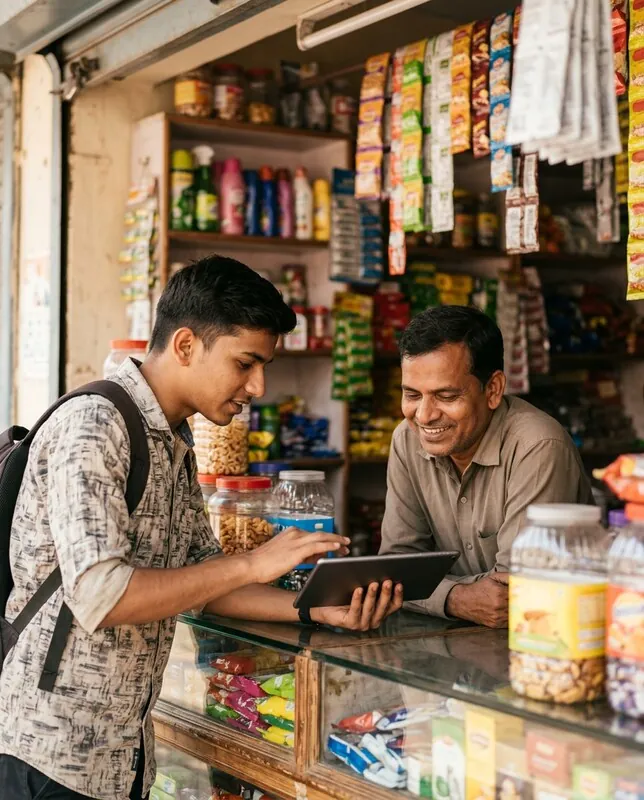
A college student showing a product demo on a tablet to a shop owner
Your rhythm

Daily, weekly and monthly.

Your tasks depend on your sub-team, and you'll see exactly what is due in your task list.

Daily

15 minutes or more

  • Open your tasks and update your deals
  • Answer chats and customer feedback for your area
Weekly

Deliver

  • Department stand-up, 20 minutes
  • Finish your weekly tasks on time and mark them done
  • Help your Startup Learners
Monthly

Learn

  • Share what worked and what didn't with your Co-Founder
  • Join the startup's all-hands: wins, numbers and goals

Which sub-team could you join?

Sales

Sales

  • Find and qualify leads
  • Run live product demos
  • Close trials into paid plans
Sales

Customer Onboarding

  • Welcome every new customer
  • Set up their workspace with them
  • Check they use the product in their first 30 days
Sales

Customer Support

  • Answer questions and feedback
  • Log bugs and feature requests
  • Help customers renew on time
Marketing

Online

  • Social media posts and reels
  • Search and website updates
  • Online ads within approved budgets
Marketing

Offline

  • Events, stalls and college drives
  • Local partnerships and referrals
  • Printed material when approved
Marketing

Branding and Content

  • Brand look and voice
  • Blogs, case studies and videos
  • Design for campaigns and the website
Profit share

Teammates share a 25% pool of net profit.

STARTIONS takes none of a startup's net profit. It goes to the students: Founders 30%, Co-Founders 45%, Teammates 25%. Your pool is split among everyone in your role, so your startup's size and your performance score decide your slice.

Pick your startup size

A Major startup has 6 Teammates. Each one's share at equal scores:

4.17%of net profit, every year
1.83%ownership, after 5 paid years
₹41,667before TDS, if net profit is ₹10,00,000
Startup typePeople in this roleProfit share, each person at equal scoresOwnership, each personIf net profit is ₹10,00,000
Micro212.5%5.5%₹1,25,000
Mini46.25%2.75%₹62,500
Major64.17%1.83%₹41,667
Mega83.12%1.38%₹31,250

Assumes every licence in the role is filled for the full year and everyone in the role has the same performance score. Score above the others and your share rises; score below them and it falls. The rupee figure is only an example of the maths, not a forecast or a promise. Bigger startups are built to serve more types of customer, but nobody can promise a bigger profit.

How profit is calculated

From customer payments to your share.

Every startup has a monthly profit and loss statement that you can read in Nirmata's Financial Tracker. Only customers' subscription payments count as earnings. Licence fees are STARTIONS' income, not startup revenue, and GST is never revenue. These numbers are an example.

Gross revenue: customers' subscription payments that year, without GST₹20,00,000
Minus discounts: approved coupons− ₹1,00,000
Minus refunds: within 30 days, in the month paid− ₹50,000
Net revenue₹18,50,000
Minus COGS: approved direct costs, such as upgrades for customers− ₹1,00,000
Gross profit₹17,50,000
Minus OpEx: approved spending, such as ads, events and mentors− ₹5,50,000
Operating profit (EBITDA)₹12,00,000
Minus tax reserve: kept aside by STARTIONS for tax− ₹2,00,000
Net profit: 100% goes to students₹10,00,000

The rules

  • Paid once a year, after the April to March financial year ends, as "Startup Execution Remuneration" with TDS deducted
  • No monthly payout and no minimum payout
  • Open only if you join before your startup's launch date
  • Your share of the pool follows your performance score, from 0 to 100, based on your real results. Equal scores mean equal shares, and written terms apply
  • Join mid-year and your share is pro-rata by the days you held the licence

When it doesn't go your way

  • A loss means nobody is paid that year, and it carries forward against next year's profit
  • An expense counts only when the Finance Committee approves it. Until then it is your own cost
  • An empty role's pool and unearned pro-rata amounts go to the startup's funds for OpEx
  • Earnings are never guaranteed: they depend on real customers and real profit
Ownership by ESOP

Stay 5 years. Earn a real share.

ESOP stands for Employee Stock Option Plan: a way for a company to reward the people who build it with a share of it. At Startions, Teammates together earn 11% of the startup, for those who complete 5 straight paid years with their licence still active. In a Major startup with 6 Teammates, that is 1.83% each.

A college student smiling at her phone and laptop on a campus bench
Year 1
Certificate at 20%
Year 2
Certificate at 40%
Year 3
Certificate at 60%
Year 4
Certificate at 80%
Year 5
Ownership earned

How you get there

  • Pay your licence fee on time every year: by hand, or turn on automatic yearly payment
  • Keep your licence active through all 5 years
  • The certificate fills 20% at each year end
  • At the end of Year 5, your share is earned

What can break it

  • The bar is progress, not part-ownership: nothing is earned before Year 5 ends
  • A late renewal past the grace period restarts your count at Year 1
  • If your licence lapses or is deactivated, your share and your completed years are lost

Check it on your dashboard

  • Your ownership certificate sits on your Nirmata dashboard, with your name on it
  • It shows your share, completed years and how far the bar has filled
  • It shows your paid-until date and whether auto-renew is on
  • It warns you when renewal is due, and shows what your share would be worth at the startup's valuation

The table above shows your ownership share by startup type. If only some people in your role qualify at Year 5, the 11% is shared among those who do, so each share is bigger. Nirmata tracks who qualifies. The legal transfer happens outside Nirmata, under written terms.

Two college students filming a short social media video with a phone
Pricing and level

₹19,995 a year, GST included.

College level, Std 11 to 15. Score 40 or more on the free readiness test and the 30% discount applies by itself at checkout, and stays on this licence each time you renew.

Teammate licenceFee18% GSTYou pay
With the discount₹16,945₹3,050₹19,995
Without it₹24,207₹4,357₹28,564
Take the free test

See every licence on the Pricing page

Launching 10 November 2026
The Grand Slam Offer

One licence. Four layers of value.

The Grand Slam Offer, launching on 10 November 2026, stacks everything you need on top of your Annual Startup Licence.

01 The Licence

Your ready startup

  • Ready-to-sell SaaS product
  • Ready brand, tech and website
  • Branded domain and business email
  • Cloud server, hosted for you
  • Nirmata platform and Advance CRM
02 Bonuses

Tools and training

  • Sales and marketing tools
  • Training to create and run a startup
  • Mentoring by si, 24x7
  • Financial know-how: pricing, unit economics, GST and invoicing
03 Super Bonus

Profit share and ESOP

  • Performance-based profit share
  • Scored by si on real results
  • A path to ownership through ESOP
04 Out-of-the-Box Bonus

Startup Loan

  • ₹25,000 for Micro
  • ₹50,000 for Mini
  • ₹75,000 for Major
  • ₹1,00,000 for Mega

For a Teammate: all four layers apply. The Startup Loan belongs to the startup, needs a unanimous yes from every licence in it, and is repaid from the startup's results over up to 3 years.

Apply for Grand Slam

Startup Loan, profit share and ESOP are subject to written terms.

Straight answers

What you're probably wondering.

How much does each Teammate earn in a Major startup?

A Major startup has 6 Teammates sharing the 25% pool, so each share is about 4.17% of net profit. If net profit were ₹10,00,000, that would be about ₹41,667 each before TDS if all six score the same. Each would also be on the path to 1.83% ownership.

I'm under 18. Can my parents pay?

Yes, and they should be involved. A parent signs the Parent NOC and the invoice shows every rupee.

Does my performance change my profit share?

Yes. Each person gets a part of the pool in proportion to their performance score. For example, if a Major startup's Teammate pool is ₹2,50,000 and one Teammate scores 75, two score 50 and three score 25, they get ₹75,000, ₹50,000 each and ₹25,000 each before TDS. The whole pool is still paid out. Your ownership share does not change with your score.

If I stop after 3 years, do I keep some ownership?

No. The certificate shows your progress, but ownership is earned only after 5 straight paid years with your licence still active. If your licence lapses, your share and your completed years are lost.

What if I miss my startup's launch date?

The licence is still yours, but the profit share is not. Profit share is open only to licensees who join before their startup's launch date. Each launch date is announced separately.

Do I need to know coding?

No. The product, website and tech are already built and looked after by the Nirmata team. Your job is customers.

What if I change my mind?

You can ask for a refund within 30 calendar days of your invoice date. Non-refundable taxes and any third-party charges shown at checkout are deducted. See the refund policy.

Ready to do the real work?

See which startups still have a Teammate licence open. Each one is limited.